Myofascial Release
An Art and Science
The state of fascia is of utmost importance as it directly influences our overall health and well-being. As a pervasive connective tissue, fascia impacts the structural integrity and function of our body. Its condition affects movement efficiency, joint mobility, posture, and even deeper, cellular function. Restrictions or imbalances in fascia can lead to discomfort, limited mobility, and various health issues. Therefore, the state of our fascia plays a crucial role in determining our overall health and quality of life.
What is Fascia? The Body’s Living Matrix
Fascia isn’t just connective tissue. It’s your body’s intelligent, adaptable, lightning-fast communication network.
It wraps and permeates every muscle, organ, nerve, and cell—and when it’s healthy, you feel fluid, clear, energized, and resilient. When it’s not? Well… things get sticky (literally and figuratively).
Free eBook – Fascia Unbound
From Mechanical Tissue to Somatic Operating System A Clinical Primer for Providers.
Dr. Mark Barnes
Fascia & the Nervous System: A Two-Way Communication System.
The Co-Pilot Role: The nervous system does not control the body in isolation—instead, it works in harmony with fascia to regulate all of our bodily functions.

Science of Fascia
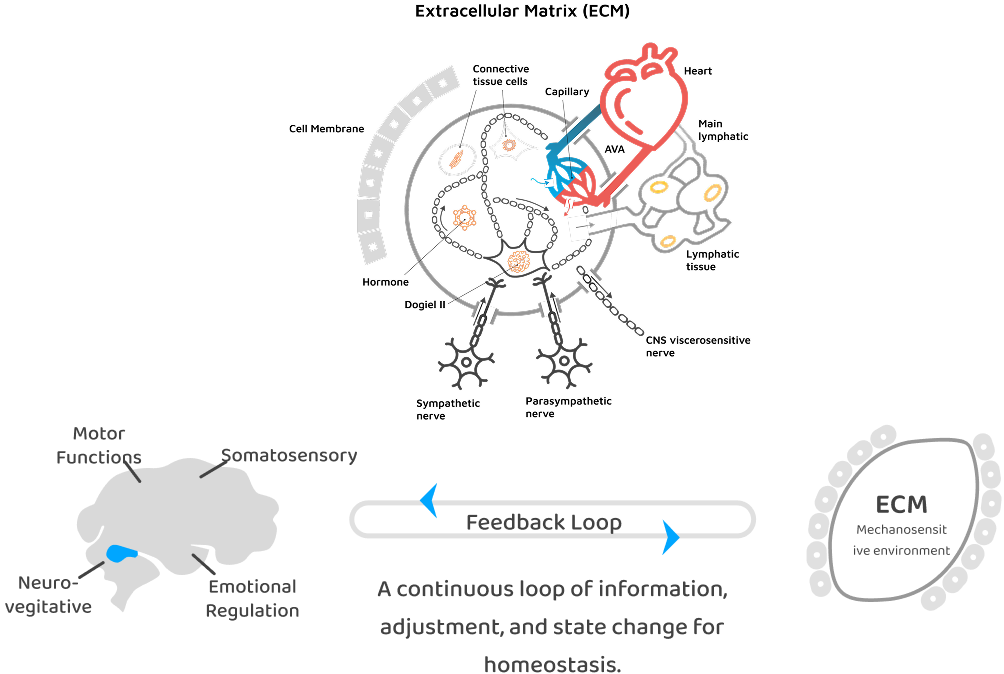
The science of fascia, as presented here, is largely based on researcher Alfred Pischinger’s system of Ground Regulation thought of as the body’s internal communication and support web. At the heart of this system is the extracellular matrix (ECM)—a fluid-filled space that surrounds all of our cells. This space isn’t empty; it’s alive with activity. The ECM is a dynamic, bioactive network of proteins (collagen, elastin), glycoproteins, and proteoglycans suspended in a hydrated gel-like ground substance. It’s not just passive scaffolding—it constantly communicates with cells, influences metabolism, manages nutrient exchange, and is the final neural pathway connecting the brain to every cell of our body. It is in this extracellular environment that all the primary regulating processes occur which make life possible.
It contains connective tissue, the smallest blood vessels (where nutrients and oxygen are delivered), and the endings of the autonomic (vegetative) nervous system. These three parts work together as an intelligent, self-regulating unit, constantly adjusting to keep the cells healthy and responsive.
The lymphatic system is also deeply connected to this matrix, helping remove waste and support immunity. Since this system reaches into every part of the body, it forms a kind of “inner ocean” that supports all the vital functions of life. It provides nutrients, clears out toxins, and is involved in every healing, inflammatory, and immune response.
Pischinger viewed this entire system through the lens of systems science—the study of how complex systems self-regulate. He described the ECM and its connections to the nervous system as a kind of biological thermostat, this is known as cybernetic regulation—a feedback loop that keeps the body in balance, or homeostasis.
Because the ECM is so deeply intertwined with the nervous system, this becomes a whole-body phenomenon. Information—like stress, touch, movement, or injury—enters the system and is instantly evaluated and responded to via this internal “thermostat.” It’s a two-way conversation: the body senses, adjusts, and then re-senses, all through this matrix. Because this system is continuous throughout the whole body, small, positive energetic changes can ripple outward and affect the entire system. Gentle movement, breathwork, somatic practices, or hands-on care can shift the local tissue environment, which then sends signals throughout the ECM and the nervous system, encouraging a global rebalancing.
It’s a powerful reminder that healing isn’t just about treating one region of the body or one system; it’s about tuning the whole system. And even small, intentional acts of self-care can create real, measurable change in our overall health and well-being.
Myofascial Release (MFR)
Myofascial release (MFR) is a hands-on therapeutic approach that views fascia—the body’s connective tissue and extracellular matrix (ECM)—as a living, responsive system rather than inert packaging. Fascia weaves through every structure, linking muscles, bones, nerves, and vessels into a continuous whole. When restrictions, dehydration, or tension build within this system, it can disrupt communication, movement, and energy flow. MFR works not by forcing tissue, but by engaging the fascia in a sustained, gentle way that allows it to soften, rehydrate, and reorganize.
At its core, myofascial release is about creating the conditions for the body to self-correct. By applying slow, sustained pressure, therapists engage both the mechanical and fluid components of fascia, opening pathways for improved circulation, cellular exchange, and nervous system regulation. Rather than “fixing” a part, MFR recognizes that symptoms often reflect a whole-system imbalance—and that restoring flow in the fascial-ECM network can reset function across the body.
The result is more than symptom relief. Patients often experience improved mobility, reduced pain, and greater ease in movement, but also shifts in energy, mood, and resilience. Myofascial release helps people reconnect with their body’s innate capacity for healing and adaptation, making it not just a manual therapy technique, but a doorway into a new paradigm of whole-body health and self-regulation.

Common Conditions Treated with Myofascial Release
Common Conditions Treated with Myofascial Release



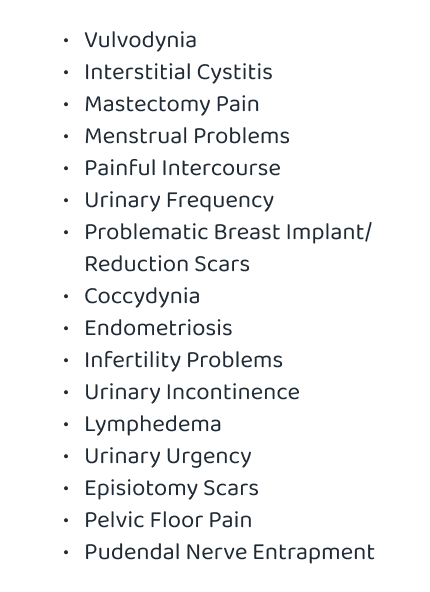
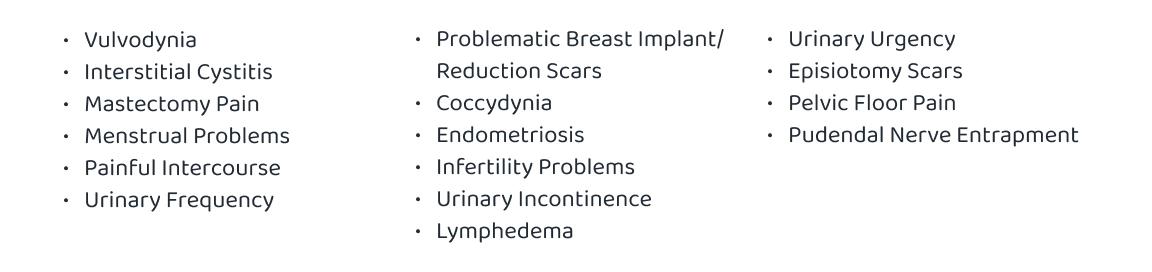
Women's Health Problems Treated with Myofascial Release
Women's Health Problems Treated with Myofascial Release